
Collections
Explore our extensive collection of rolling stock, inspection vehicles, more than 10,000 artifacts, and archival and library materials.
Locomotives
Canadian Northern 1112 Steam Locomotive
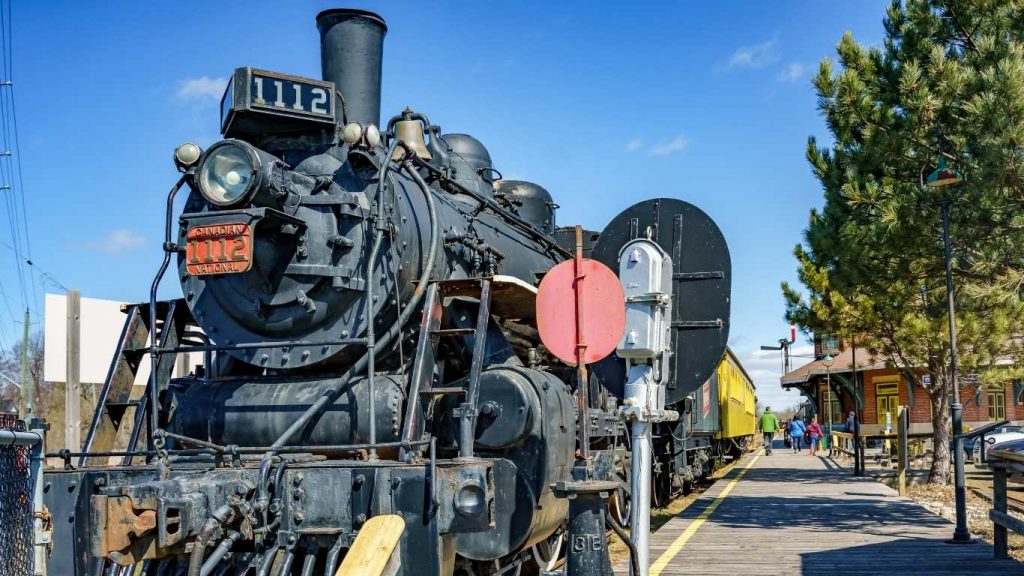
CNR 1112 ten-wheeler (4-6-0) was originally built by Montreal Locomotive Works in 1912. This engine was one of fifty “G-16-a” class engines constructed between 1912 and 1913 for Canadian Northern Railway, which due to bankruptcy, was folded into the federal government created Canadian National Railways (CNR) in 1919. Engines from this class were strong yet simple, perfectly suited for the light duty jobs typically assigned to them, employed in both freight and passenger service.
Built as a coal-burner, it was converted to burn oil by the Quebec, North Shore, and Labrador Railway who purchased it, along with another G-16-a, from Canadian National Railways in 1952. Most of this class lasted into the mid to late 1950s before being retired.
Upon its retirement from the QNS&L in 1961, it was donated to the Canadian Railroad Historical Association, and became one of the first locomotives at the Canadian Railway Museum (ExpoRail) in Saint-Constant, Quebec, and the first to be kept indoors (November 24, 1962). CRM later leased the locomotive to the Railway Museum of Eastern Ontario for display. It was moved to the museum grounds on June 6, 1992.
Only one other locomotive of its class was saved from the scrapper’s torch, 1158, currently on display at the Western Development Museum in North Battleford, Saskatchewan.
Cylinders 20” x 24” (50.8 cm x 61cm)
Driver wheels 57” (145cm) 14 spokes
Boiler pressure 180 lb. per square inch (1225kPa)
Weight of engine 71 tons, weight of tender 18 tons empty (77 tons with boiler filled and 62 tons loaded with oil or coal)
Length 62 feet (19m)
Tractive Effort 24800 lb. (pulling power)
Brookville #4
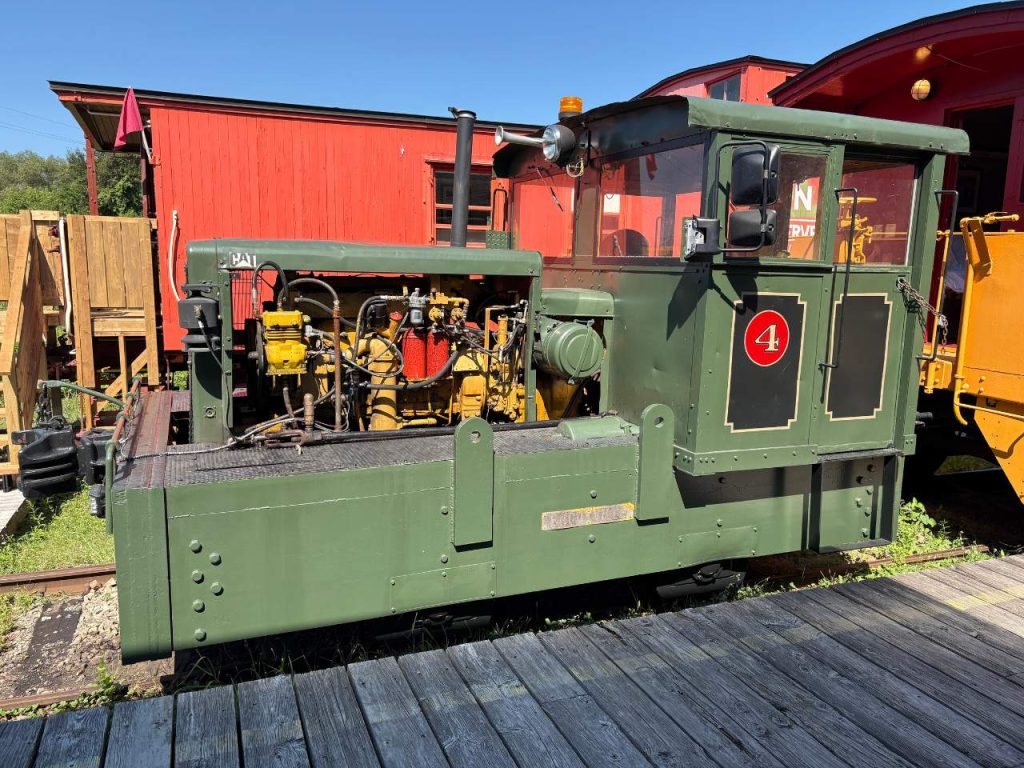
More content coming soon!
Green Frog Trackmobile

A trackmobile has steel flanged wheels for movement on rails and retractable rubber tires for movement on the ground. The steel wheels remain in place while the rubber tires can be raised and lowered to fit the needs of the operator.
The Green Frog trackmobile was a vital part of the switching operation at the Hershey Chocolate Company facility in Smiths Falls. It could move three fully loaded box cars, filled with sugar, to the unloading doors then have them ready to be collected by a CPR local switching train.
The Hershey/RMEO Green Frog trackmobile was rescued from a scrap yard by RMEO legend John Weir.
Canadian Pacific 6591 Diesel Electric Locomotive

Montreal Locomotive Works constructed the Canadian Pacific #6591 in July of 1957 as a S-3 model diesel-electric locomotive switcher. CP assigned the 6591 to Smiths Fall to operate way freights, where it alternated with other locomotives (#6528, #6551) on assignments on the Brockville, Prescott and occasionally the Kingston branch lines. They occasionally handled the north way freight on the Chalk River subdivision as well. It served all of it’s life in the Smiths Falls CPR yard and area. CP#6591 was retired by CP December 7th, 1982 and was donated to RMEO in 1985.
It is powered by a normally aspirated model 539 diesel engine, producing 660 horsepower. The locomotives were plumbed with air communicating signals for passenger service and were equipped to provide electricity to Snowplow headlights. They were geared for a maximum speed of 104.607 KPH (65 MPH).
Restoration began on the locomotive in 1986, where it was repainted in the original livery of CP maroon and grey. The engine was repaired and started by volunteers for the first time on June 6th, 1989. The 6591 continues to operate and is used by the museum for moving our rolling stock collection around the museum property
Cabooses
Canadian National Caboose 79274

CN 79274 was built in 1967 by Hawker Siddeley. Originally a CN caboose used from 1967-1986 it was put into service by Dupont Canada in Maitland, ON. The caboose, built with steel, is modern in comparison to the wooden cabooses at the museum.
Canadian National Caboose 79095
CN 79095 was originally a boxcar built in 1921 in one of CNR’s London Shops. It was converted into a caboose in 1957 and in 2001, it was donated to us and restored.
Canadian Pacific Caboose 437183
CP 437183 was built in 1945. Despite material rationing during the intra-war period, this caboose uses plywood installed over tongue and groove siding.
Canadian Pacific Caboose 436757

Built in 1921, CP 436757 was relocated to the RMEO in 1992. Tourists may find it looks familiar since it served as the Smiths Falls Tourism Information Booth for many years!
Rolling Stock
CN 574493 "AutoCar" Automobile Boxcar
Canadian National 574493 wooden automobile boxcar was built in 1927 by Canadian Car and Foundry. Through its life, it has gone through several name changes. The car was originally CN 582609, then CN 574493, then CN work service car 74428, and finally part of the Tunnel Bay Model Railroad display in Brockville.
 This wooden automobile boxcar was built with double doors to transport automobiles such as the Ford Model T. Model T chassis were chained to the ceiling of the car using brackets. This allowed more vehicle chassis to be transported. Count the sets of brackets to figure out the maximum number of chassis that could be carried. The bodies of the cars were transported in a separate boxcar.
This boxcar was also used for general freight. Often the car would transport automobiles to Western Canada and return to Eastern Canada with grain or lumber. Grain was transported with a special door system. Wood was boarded across the regular door frames and then paper was used to seal any cracks. Grain was then loaded into the car and finally, at the destination, the paper and boards were discarded so that grain could be removed. By using a special door system, less grain was lost during the trip.
Its difficult work to safely load or unload a boxcar with several expensive automobiles. Despite the extra wide door opening it’s a challenge to manoeuvre a new car without touching a box car door or wall and creating expensive damage.
On the return trip from Western Canada to the east, loads of various grains were dropped in from chutes originating from above in trackside grain elevators. The extra wide doors were sealed with boards to contain the grain and allow doors to be closed. At the destination, boarding was removed, and gravity did most of the unloading. It was dusty and very little air moved as a man with a shovel waded through grain into the ends and corners of the car and muscled out the last of the precious load.
Look for the markings on the walls of the boxcar to see which grain products are denser than others. The lower the mark on the wall the denser the product. Once the car was cleaned it was made ready for another west bound trip with automobiles.
Dental Car 15095
CNR Dental Car 15095 was built in 1913 for CNoR as a heavy weight sleeping car outfitted with mahogany. This mahogany is still intact in the front and rear ends of the car. The car went through several name and number changes including being called “Camrose”, after the town of Camrose, Alberta. The sleeping car could hold 26 passengers. It traveled more than a million miles over 40 years before it was retired from active passenger service in 1951.
In the 1930s the Ontario government funded a programme to provide dental care to children in remote Northern Ontario communities. Canadian Pacific donated two old passenger cars and Canadian National donated one. These cars were then converted into dental cars for the dentists to live and work on.
Dining Car 4006
Built in 1899 by the Wagner Palace Car Company in Buffalo, New York as a passenger train, this car was one of the final railcars completed before the company was acquired by the renowned Pullman Company of Chicago on January 1, 1900.
Car 4006 began its service with the Intercolonial Railway, transporting passengers between Halifax and the Grand Trunk Railway connection at Rivière-du-Loup on the St. Lawrence River. It later became part of the Canadian National Railways fleet. It was restored into a dining car in 1952 to serve as part of the Canadian National Railway Museum Train.
The dining area features ten tables—five on each side of the central aisle—accommodating between 20 and 34 passengers, depending on how cozy they were willing to be. Overhead, the original lighting fixtures once burned kerosene or another clean fuel, illuminating meals served in motion. A long cord near the ceiling could be pulled by the Conductor to communicate with the Engineer.
Snowplow 55400
 CNR 55400 snowplow was built in 1935 by National Steel Car in Hamilton. This snowplow is a single-track wedge plow with wings. The wings are operated by compressed air from the brake system.
The Plow is huge in size weighing 65,700 lbs, reaching 33 feet long, and is 16 feet high.
The lower front section of the plow could be raised to avoid potential damage to switches and level crossing planks and derailments. Trackside signage warned the snowplow operator to raise the front sections.
Inspection Vehicles
CNR 23 Wickham Car
 Wickham cars were built by Wickham in England. Only six of these cars were ever transported to Canada. The Canadian National 23 Wickham car was built in 1954.
Wickham cars were used for rail inspection and track crews. The cars could carry up to nine people in a climate-controlled enclosure, which is bi-directional. Speed wise, the Wickham cars were comparable to a car on a highway. In the past the museum was able to offer rides on the Wickham cars but these rides are no longer available.
Handcar & Velocipede
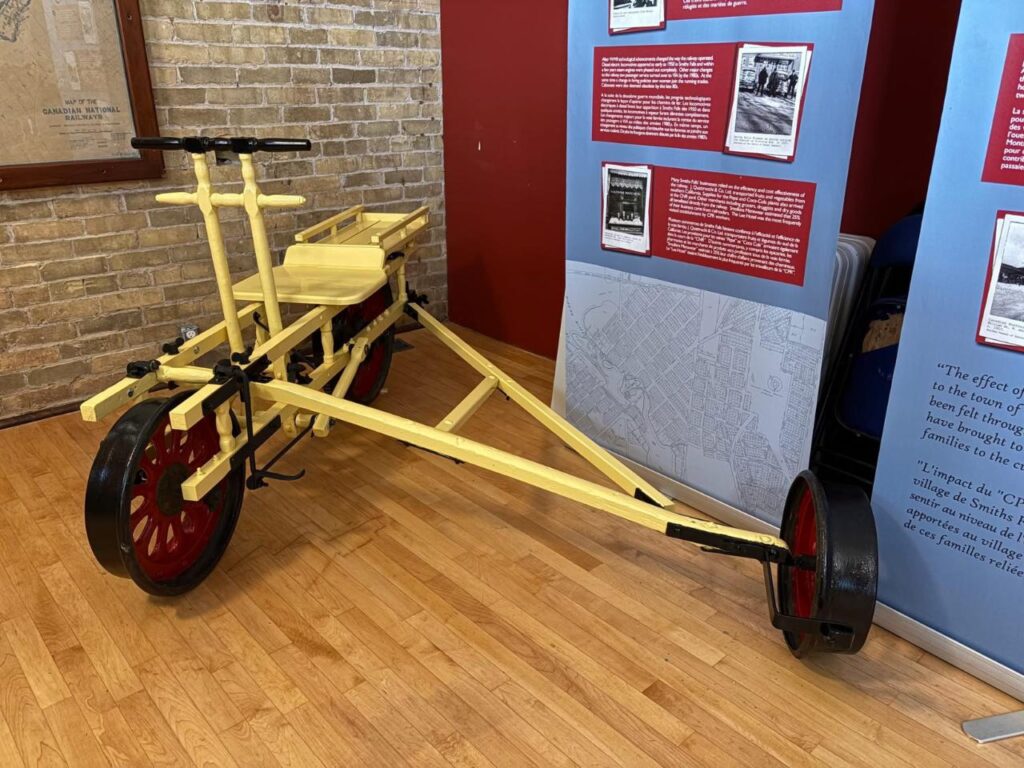 Throughout railway history, track crews used various means to get to the problems on the track. Early in rail history, track crews used handcars and velocipedes.
With room for four men, handcars could reach a top speed of about forty kilometers an hour. The much smaller Velocipede could carry 1 worker and their toolbox.
CPR M-260 Cadillac Sedan Limousine
 The 1947 Cadillac sedan limousine originally ran as a regular car on the road. It was owned and operated by a Toronto medical doctor. The doctor was a friend of CPR president N.R. “Buck” Crump. The doctor donated the car to Crump for his use. CP sent the car to Montreal where it was converted to run on rail. The car was then assigned to the president or general manager as a convenient and comfortable inspection vehicle. It was operated as a train for safety reasons. It was driven by division superintendents who were qualified operators who could also inform the senior manager about the condition of their division.
The eight-cylinder engine moves the seven tonne car down the track. The Cadillac is identified as M-260. The conversion added a turntable underneath the car so that it can be reversed on the track so it could run in either direction. Air brakes, an air horn, and a bell were added. The steering wheel became part of the air brake system. M-260 has only 52 000 kilometres of service.
Speeder
Motorized cars were eventually introduced and used instead of manually driven handcars. Speeders were a quick and efficient way to transport crews. Many railway companies now use trucks that can run on the rails to transport crews and equipment.
Buildings
Section House
The CN duplex Section House, threatened with demolition, was moved from the south side of William Street onto the Railway Museum property. The Section House exterior was restored.
Nolan's Flag Station
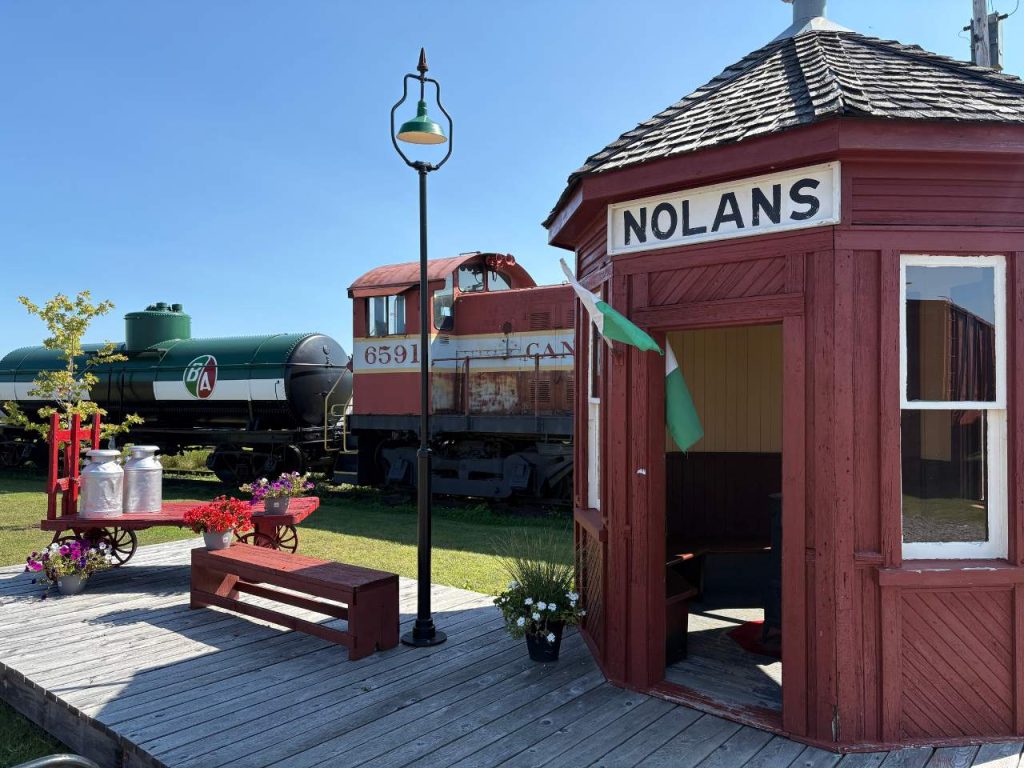
Brought to us from Nolan's corners, this would be the first stop for people travelling on the local Shortline. Inside you'll find flags and lanterns, both were used to signal to the engine to stop and pick up passengers.