
Museum History

The Railway Museum of Eastern Ontario is located on 10.5 acres in the heart of Smiths Falls. Our station building, built in 1912 by the Canadian Northern Ontario Railway, is a National Historic Site.

Efforts to acquire this station began in April 1979, when Canadian National embargoed their Smiths Falls Subdivision between Smiths Falls and Strathcona. VIA responded by moving their night trains over to the CPR Brockville Subdivision, and CN applied for permission to abandon and demolish the station building.

Local resident Bill LeSurf took up the cause, hurriedly gathering support from people and organizations across the region. The interim “Save Our Station” (SOS) committee evolved over time. It grew into what is now the Smiths Falls Railway Museum Corporation. Bill’s efforts succeeded in obtaining a reprieve for the station, and negotiations with CN began in earnest.

1985 was a busy year, as the station received a new roof, much new paint, and the property was cleaned up. A temporary museum display was established in the only portion of the building that was safe to the public, the express room.

In October 1985, Parks Canada unveiled a plaque on the station, declaring it a National Historic Site.

Over the following fifteen years, massive efforts went into the rehabilitation of the station building. Collapsed floors and ceilings were removed and replaced, and all of the glass was replaced. Electrical, heating, plumbing, and drainage systems were renewed. The ornamental plaster work, wooden trim, and hardwood floors were repaired or replaced as necessary. The asphalt station platform was removed, and a brand new platform was constructed from British Columbia fir timber to the original platform’s specifications. The train order signal equipment was acquired from a demolished station, restored, and installed.

As land purchases gradually added to our holdings, several surrounding buildings were acquired. The CN freight shed and a feed mill warehouse were demolished to clean up the site.

The CN duplex Section House, threatened with demolition, was moved from the south side of William Street onto the Railway Museum property. The Section House exterior was restored.

Our station

Women's Waiting Room

The start of your journey through the museum, our modern day gift shop was originally the designated waiting room for women and children. 

Men's Waiting Room

Originally only for the men, our main waiting room now hosts vintage railway benches and static displays. 

You can access every other part of the museum from here.

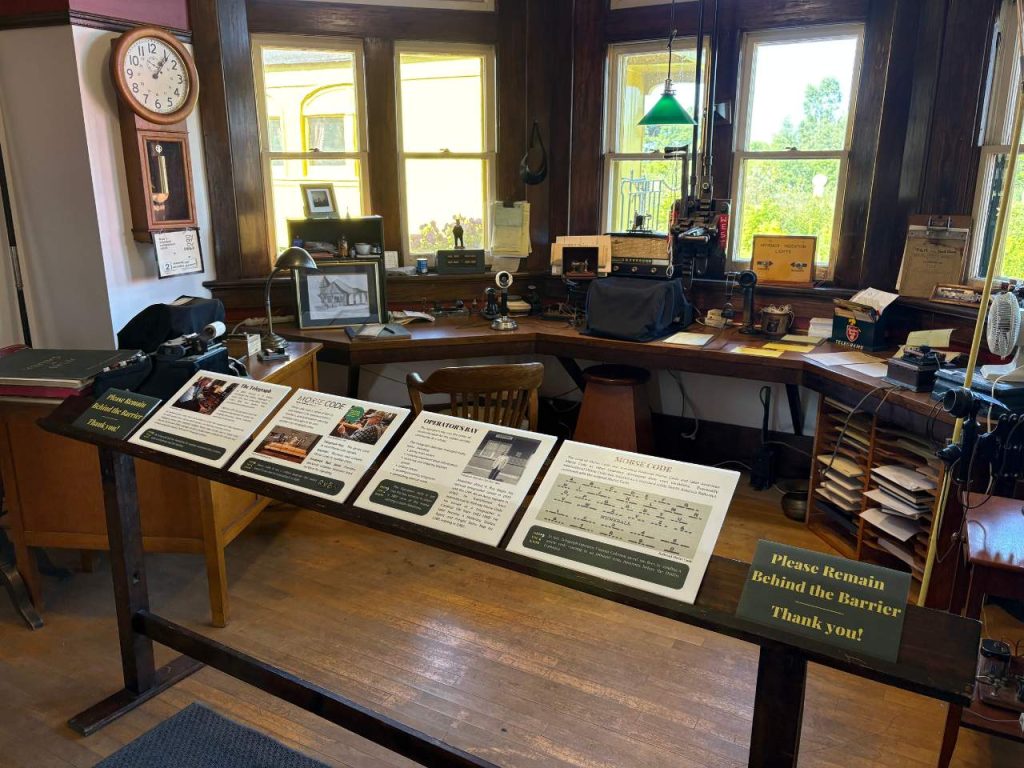
Telegraphers Office

The operator's bay was the center of communication for the station and for the community as a whole. The telegraph operator had many tasks to complete: receiving and shipping express goods, selling tickets, giving train orders to train crews, sending/receiving telegrams, completing clerical work, and representing the railway to the public.

When visiting, drop by the operator's office to watch the operator recreate these tasks. Ask the operator to send a telegram for you using Morse Code.

Telegraphy was last used in Canada on the railway in 1972. As the original texting machine, it still outperforms texting on cell phones in most competitions. Ask the operator to challenge you to a messaging duel!
Baggage Room

Bags, coats, and luggage would be loaded from the baggage room; a side room on the east end of the men's waiting room.

Today you'll find a map of Eastern Ontario railway lines, static displays, and local history.